
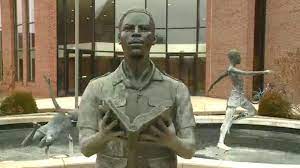
It is an amazing ongoing phenomenon: though dying of a respiratory illness while attending Taylor in the late 19th century, Liberian student Samuel “Kaboo” Morris’s story continues to touch lives as one of the most significant individuals to have influenced the institution since its inception in 1846.
We invite you to learn more about the Angel in Ebony: his story, the people he personally touched, and his impact still today.
A Life Dedicated to God
Miraculous Escape
Over 130 years ago, in a small Liberian village in West Africa, Samuel Morris was born Prince Kaboo, the eldest son of a Kru tribal chieftain. While still a child, a neighboring clan defeated his people and demanded Kaboo’s father pay a hefty ransom for his son’s return.
The conquering chief subjected Kaboo to terrible treatment and cruel labor. During one of many intense whippings, Kaboo said he saw a bright light and heard a voice from Heaven telling him to flee. Kaboo recalled the rope binding him fell to the ground; he gathered his strength and ran into the jungle.
Traveling at night and hiding in the hollow of trees by day, Kaboo navigated blindly through a jungle dominated by jungle law. Eventually he arrived at Monrovia, the one civilized city with thousands of Liberians under governmental law. There, a young boy invited Kaboo to church where Miss Knolls, a missionary and graduate of Taylor University (then known as Fort Wayne College), spoke on the conversion of the Apostle Paul. Kaboo immediately saw similarities between his story and Paul’s. Shortly afterward, he accepted Christ as Savior and was baptized under the name of Samuel Morris in honor of the missionary’s benefactor.
Faith to Move a Mountain
Morris spent the next two years painting houses in Monrovia, the capital of Liberia. He became a zealous member of the Christian community and displayed a fervent desire to learn about the Holy Spirit. Lizzie MacNeil encouraged him to travel to America and seek the instruction of her mentor, Stephen Merritt, former secretary to Bishop William Taylor. With no money or means of transportation, Morris began his journey on foot.
From Liberia to New York
Sleeping on the beach at the Robertsport harbor, Morris waited several days before finding passage on a ship in exchange for work. The journey was difficult; Morris was often beaten and assigned to the most dangerous tasks. However, by the time the ship docked in New York in September 1891, the captain and most of the crew had accepted Christ because of Morris’ witness.
Once he arrived in America, Stephen Merritt warmly received Morris. He contacted Thaddeus Reade, then president of Taylor University, and requested to enroll Morris at the school. Due to Taylor’s financial debt, Reade personally started a fund for Morris. Reade’s effort would later be known as the “Faith Fund.”
The “Angel in Ebony” at Taylor University
In December 1891, Morris arrived on Taylor’s campus (then in Fort Wayne, Ind.). When asked by Reade which room he wanted, Morris replied, “If there is a room nobody wants, give that to me.” Morris’ faith had such a profound impact on the Fort Wayne community he was frequently invited to speak at local churches. At night, he could be heard in his room praying, which he simply called “talking to my Father.”
President Reade once said, “Samuel Morris was a divinely sent messenger of God to Taylor University. He thought he was coming over here to prepare himself for his mission to his people, but his coming was to prepare Taylor University for her mission to the whole world. All who met him were impressed with his sublime, yet simple faith in God.”
Morris’ Death
On May 12, 1893, Samuel Morris died after contracting a severe cold. His death inspired his fellow students to serve as missionaries to Africa on his behalf, fulfilling his dream of one day returning to minister to his own people. Hundreds of spectators lined the streets of Fort Wayne as Samuel Morris’ body was carried to Berry Street Methodist Church.
Lindley Baldwin, author of Samuel Morris, writes, “The burial ceremony in Lindenwood cemetery, his last earthly resting place, was attended by a multitude such had never before accompanied there.” Morris’ untimely passing prevented him from participating at the laying of the cornerstone at Taylor’s new Upland campus, where he was scheduled to speak and sing.
Morris’ burial at Lindenwood Cemetery in Fort Wayne drew hundreds from near and far. The location of his original gravesite, however, remains unknown. In 1928, Taylor’s senior class had Morris’ grave relocated to a more prominent place in Lindenwood Cemetery in Fort Wayne, IN and dedicated a new monument. It remains one of the most frequently visited graves in the cemetery.
The Continuing Story
With men of great faith come great testimonies. Samuel Morris is no different. Within months of his passing, his incredible story began a journey around the world continuing far into the next century and beyond with a voice that could not be silenced.


